Introduction: Growth In The Wrong Direction
What if the problem isn’t that you’re not growing fast enough, but that you’re actually growing in the wrong direction?
I want you to really sit with that question for a moment, because I think for most people, growth starts out feeling exciting. It feels like momentum and validation. It feels like proof that the thing you’re building is working.
And for a while, it genuinely is exciting.
But then, somewhere along the way, there’s often a quiet shift that happens. Growth stops feeling like something you’re consciously choosing and starts feeling like something you’re being pushed into. You’re surrounded by messages about what you should want next — more clients, more offers, more visibility, more scale — and certain milestones start to become the benchmark for whether you’re doing business “properly”.
And on the surface, things might still look good. Revenue might be increasing. Opportunities might be coming in. Other people might be telling you how well you’re doing. But internally, something doesn’t quite sit right.
The business might be growing, but your capacity isn’t growing with it. Instead of feeling expansive or energising, growth starts to feel heavy. Noisy. Like it’s creating more complexity instead of more freedom. More decisions instead of more clarity. And you might not even be able to articulate exactly what’s wrong — you just know that this isn’t what you thought growth was meant to feel like.
And this is the part we don’t talk about enough. Just because something looks like growth on the outside doesn’t mean it’s the right kind of growth for you.
So in this episode, I don’t want to talk about doing more for the sake of it. I don’t want to talk about pushing harder or chasing the next shiny milestone. What I want to talk about is having the courage to question the way we’ve been taught to grow, and how to make growth decisions that actually support your definition of success — not someone else’s.
Because growth isn’t about doing more. It’s about having the courage to choose the right lever at the right time, in a way that protects your definition of success.
Growth isn’t one thing
One of the biggest things I wish I’d understood earlier in business is that growth isn’t this single, linear path that everyone moves along in the same way.
I think we’re taught — often without even realising it — that if we want to grow, the answer is just to push harder. Do more marketing. Create more offers. Bring in more clients. And in the early stages of business, that approach can actually work. You do need momentum. You do need traction. You do need to build visibility and confidence.
The problem is that this “push harder” narrative often gets carried forward long after it stops being the right one.
As businesses mature, the way they grow changes. What worked when you were building traction doesn’t necessarily work when you’re trying to build sustainability. And what helped you grow revenue doesn’t automatically help you grow profit, capacity, or freedom.
Over time, what I’ve learned is that growth actually comes from a number of different places. There are different ways a business grows, and different ways it becomes more profitable, more sustainable, and more aligned — and those things don’t always come from doing more.
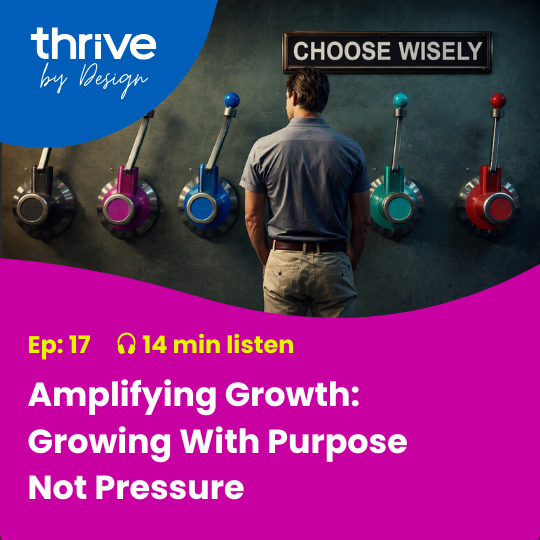
I like to think about growth as a set of levers. Different ways you can influence what happens next in your business, depending on where you’re at, what you want to achieve, and what you realistically have the capacity to hold in this season of your life.
And this is where I see a lot of people get tripped up.
They assume that if there are multiple ways to grow, they must need to pull all of them. More leads and more offers and higher prices and new markets — all at once. And that’s usually where growth starts to feel chaotic instead of intentional.
Because the truth is, your job isn’t to do everything. Your job is to choose.
When you realise that growth is about choosing the right lever — not all of them — everything starts to feel a little calmer. A little clearer. You move out of reaction mode and back into decision-making mode.
At a high level, there are seven main ways a business grows. You can focus on:
Bringing in more leads.
Converting the leads you already have more effectively.
How often clients buy from you.
The value of what they’re buying.
Keeping clients for longer.
Improving efficiency and margins.
Introducing new products, services, or moving into new markets altogether.
All of those are valid. Every single one of them. But they don’t all have the same impact, and they definitely don’t all make sense at the same time.
And this is where growth starts to become a strategy instead of a scramble.
Where people get stuck
This is where I want to be really honest, because this is the part that keeps a lot of people stuck without them even realising it.
Most of the time, when someone tells me they want to grow their business, they default straight to the same lever: more leads. More marketing. More visibility.
And on the surface, that makes sense. More leads feels active. It feels productive. It feels like you’re doing something about growth.
But here’s the problem. If you don’t understand what’s happening after those leads come in, more leads don’t fix anything — they just amplify whatever’s already there.
If your conversion rate is low, more leads just means more people saying no. If your pricing isn’t right, more leads just means more underpaid work. If your capacity is already stretched, more leads just adds pressure and complexity.
Often, the biggest opportunities for growth aren’t sitting somewhere out there in a new marketing channel. They’re already inside the business. They’re in how well you convert. How clearly you communicate value. How confident you are in what you’re charging. How intentionally you design the client journey.
Another place I see people trip themselves up is completely overlooking their existing clients. Everyone’s so focused on who’s next that they forget about who’s already said yes.
And the reality is, it’s almost always cheaper and more effective to earn more from an existing client than it is to go and find a brand new one. Existing clients already trust you. They already understand your value. They already have a relationship with you.
But that kind of growth doesn’t feel as exciting. It doesn’t feel as visible. There’s no dopamine hit of new leads rolling in. So people skip over it — even though it’s often the lowest-hanging fruit in the business.
And then there’s the urge to add. A new offer. A new service. A new market. Because when growth feels uncomfortable or slow, adding something new feels like forward motion.
But more often than not, what it actually adds is complexity. More decisions. More delivery pressure. More moving parts. And it doesn’t fix the underlying issue.
Sometimes the work isn’t to add more. Sometimes the work is to simplify, refine, and deepen what’s already there.
This is why I keep coming back to the same point: growth isn’t about pulling more levers. It’s about pulling the right one — deliberately, and with intention.
Why numbers matter (without turning you into a spreadsheet person)
Now, if you’re listening to this and thinking, “Okay, this all makes sense, but I still don’t know which lever I should be pulling,” I just want to pause here and say — that’s completely normal.
This is usually the moment where people think they need a better strategy, when what they actually need is a bit more clarity on where their business is really at.
And this is where numbers come in.
Not in a finance-bro, spreadsheet-obsessed way. And not so you can compare yourself to anyone else. But because without that clarity, you’re essentially making growth decisions in the dark.
Most people don’t avoid their numbers because they’re bad at business. They avoid them because numbers feel confronting. Or overwhelming. Or tied to someone else’s definition of success. There’s often a lot of emotion wrapped up in them.
But when I talk about numbers, I’m not talking about chasing arbitrary targets. I’m talking about responsibility.
Responsibility is knowing where you are now. Understanding what’s actually working. And being able to make intentional decisions about what comes next.
If you don’t know how many leads you’re bringing in, how well you convert them, how often clients buy, what your average transaction looks like, or what your margins actually are, it’s almost impossible to decide how to grow — or to grow without sacrificing yourself in the process.
Once you have even a high-level understanding of those things, something interesting happens. Choosing a growth strategy becomes simpler. Calmer. You’re no longer guessing or reacting to the loudest advice in the room. You’re responding to what your business is actually telling you.
And while we’re here, I need to say this. I am so tired of the obsession with arbitrary revenue milestones — especially the whole “you’re not successful until you hit 10K months” narrative. It’s lazy, it’s overused, and it strips growth of all context.
Ten thousand dollars a month means nothing if it comes with no margin, no capacity, and no sustainability. Revenue without alignment isn’t success. It’s just noise.
Scaling without sacrifice (a lesson I learned the hard way)
There was a point in my own business where, on paper, growth looked like it was heading in the right direction. We were doing well. Things were moving. And from the outside, it probably looked like the obvious next step was to keep scaling in the way everyone else around us was scaling.
But if I’m really honest, there was always something about it that didn’t sit right with me.
I had deliberately designed my business to work in a certain way. Flexibility mattered to me. Autonomy mattered. Working from home worked for me. It supported my life rather than competing with it.
And yet, I started listening to voices that told me that if I didn’t have a physical office, a visible team sitting in that office, a more traditional setup, then I’d never really get to the next level.
So despite those reservations, we went ahead and did it. We took on an office. We built around that model. And very quickly, it became clear that it wasn’t right — not for me, and not for the business.
What’s interesting is that instead of creating momentum, it actually did the opposite. The business contracted. And I pulled back. Not because I wasn’t capable, but because the way we were growing didn’t align with who I was or how I wanted to work.
Looking back, the biggest mistake wasn’t the office itself. It was letting someone else’s definition of success override my own.
That experience really cemented something for me. If growth requires you to compromise your values, your goals, or the way you want your life to look, it’s probably not the right kind of growth — no matter how good it looks on paper.
Bringing it back to you
And I think this is where Thrive by Design really comes into play.
Because thriving doesn’t happen by accident. It doesn’t come from chasing growth reactively or building a business around what everyone else says it should look like. Thriving happens when you make deliberate choices — when you design your business in a way that actually supports you, not just the numbers on a page.
Thrive by Design is about stepping out of default mode. It’s about recognising that you always have more choice than you think — in how you grow, what you prioritise, and what you’re willing to trade off. Or, just as importantly, what you’re not willing to trade off.
When growth is designed intentionally, it stops being something that happens to you and starts becoming something you actively shape. You’re no longer reacting to pressure, trends, or someone else’s definition of success. You’re making decisions from clarity instead of urgency.
And that’s really the heart of amplified growth. It’s not about asking, “How do I get bigger?”
It’s about asking, “How do I build something that actually works for me — now, and in the long term?”
Because when you grow by design, not by default, growth becomes sustainable. It becomes aligned. And it becomes something you can actually enjoy, rather than something you’re constantly trying to keep up with.
So as you think about what’s next for your business, my invitation is to come back to that idea. To pause before you push. To choose before you scale. And to remember that thriving isn’t about doing more — it’s about designing better.
And when growth is designed with intention, courage, and clarity, it stops feeling like pressure… and starts feeling like progress you actually want to carry forward.
Until next week, keep thriving - but do it by design, not by default.
Crafting a Business You Love
Build a business that works for you. This free guide will help you realign your strategy, simplify what’s holding you back, and design a business that gives you more time, freedom, and fulfilment.
Get your free copy and start crafting a business you truly love.