Introduction: When the Business Starts Asking for a Different Version of You
There’s a moment in business growth that often catches people off guard. It’s not the early days, when everything feels uncertain but exciting. And it’s not the later stage, when the business feels stable, spacious, and well-resourced. It’s the stage in between — when things are objectively working, but subjectively feel heavier than they should.
If you’re sitting somewhere in multi-six figures, and you’re looking toward seven figures and beyond, this stage will feel familiar. Revenue is coming in. Clients value your work. You might even have a team around you now. From the outside, the business looks successful. From the inside, it can feel like the business needs more of you every year, not less.
You might notice you’re constantly “on.” Constantly thinking about the business. Constantly holding things in your head. Even when you’re not working, you’re not really off. And at some point, a quiet question starts to surface — if this keeps growing like this, how sustainable is it actually going to be?
This is usually where people assume they need to optimise. Better offers. Better systems. Better productivity. And while those things absolutely matter, what’s really happening here runs deeper than tactics.
The business isn’t asking you to do more. It’s asking you to lead differently.
And that’s where the CEO conversation really begins.
The Messy Middle: When Growth Outpaces Structure
Most service businesses don’t struggle because the work isn’t good enough. They struggle because growth introduces complexity faster than the founder’s role evolves.
In the early stages, being deeply involved is an advantage. You’re close to clients, close to delivery, and decisions are intuitive. You can move quickly because everything lives inside your head. That closeness often creates the momentum that gets the business off the ground in the first place.
But as the business grows, that same closeness becomes a pressure point.
More clients mean more delivery, more expectations, more moving parts. A team means more questions, more decisions, more emotional responsibility. And suddenly, instead of growth creating relief, it creates fragility. Things still work — but they work because you’re constantly switching contexts, constantly responding, constantly holding everything together.
This stage has a very particular texture to it. Your calendar is full, but the important thinking keeps getting pushed. You’re busy, but you still feel behind. There’s very little white space, and when it does appear, it’s usually filled with catching up rather than getting ahead.
And often, this is where resentment starts to creep in quietly. Not resentment toward the business itself — but toward the fact that growth hasn’t brought the freedom you expected. Instead of feeling more supported, you feel more responsible. Instead of feeling more spacious, you feel more needed.
What makes this stage so tricky is that nothing is technically “wrong”. The business is working. Which makes it harder to justify changing how you operate. But underneath it all, there’s a growing sense that this version of you cannot keep scaling.
That tension isn’t a failure. It’s a signal. A sign that the business has outgrown the way it’s currently being led.
From Expert to Leader: Stepping Out of the Centre
One of the hardest shifts for servicepreneurs at this stage is letting go of the identity of being the expert.
Your business exists because you’re good at what you do. Your thinking, your delivery, your judgement — those things matter deeply. But as the business grows, your expertise can no longer sit at the centre of everything. Seven-figure growth requires you to move from being the primary source of value to being the person who creates the conditions for value to be delivered well, consistently, and without you being involved in every moment.
This is where leadership starts to feel uncomfortable.
Doing feels productive. Leading feels slower. And if you’ve built your sense of contribution around output, it can quietly trigger the question, If I’m not doing, what am I actually contributing?
This is often where people start working harder again. Taking more back on. Staying closer to the work than they probably should — not because it’s strategic, but because it feels grounding and familiar.
That tension is usually the first sign that your identity is shifting — whether you’re ready for it or not.
Identity Resistance: Why “CEO” Feels Like Too Much
This is where I want to slow down, because this part matters.
Many servicepreneurs are comfortable calling themselves business owners, but not entrepreneurs. And there is often strong resistance to the word CEO.
For some, CEO feels corporate. Cold. Ego-driven. For others, it feels disconnected from the care, integrity, and closeness that drew them into service-based work in the first place. There’s often an unspoken fear that stepping into the CEO role means becoming removed, inaccessible, or overly focused on growth for growth’s sake.
And layered underneath that is another belief — I’ll step into that role later. When the business is bigger. When it feels more legitimate. When things are calmer.
But here’s the hard truth. The business doesn’t wait for you to feel ready.
The moment your business relies on people, systems, and decisions beyond your own effort, leadership is already required. Whether you claim the CEO identity or not, the role exists.
Avoiding that identity doesn’t remove responsibility. It just leaves leadership undefined. And undefined leadership is one of the biggest reasons service businesses stall in this stage. Not because the founder isn’t capable, but because they’re trying to run a complex business while still operating from a smaller identity.
Ironically, resisting the CEO role often erodes the very values people are trying to protect. Without clear leadership, pressure increases. Decisions become reactive. Boundaries blur. And the business starts demanding more, not less.
Stepping into CEO leadership isn’t about ego. It’s about responsibility — and sustainability.
The 10 Hats in Business: Why Everything Starts to Feel Heavy
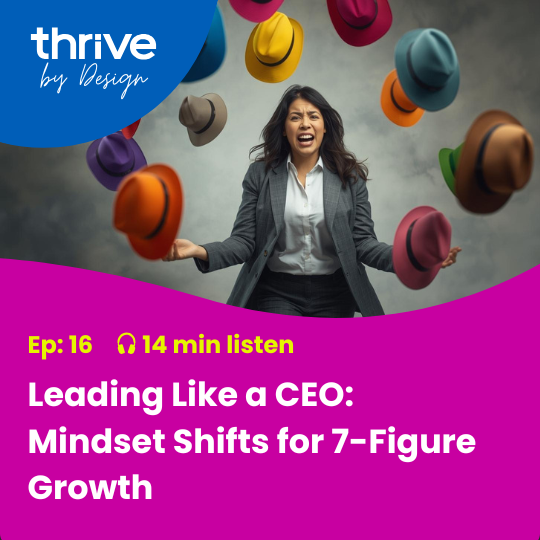
This is where the 10 hats framework becomes incredibly clarifying.
In the early stages of business, founders wear all ten hats. Sales. Marketing. Delivery. Admin. Finance. Operations. Client experience. Systems. Strategy. Leadership. Everything sits on one head, and for a while, that works — because the business is small enough to live inside your mind.
But growth doesn’t remove hats. It adds weight.
What I see consistently in service-based businesses is that founders don’t consciously decide which hats to put down. They just keep adding more. And the hats that tend to be the hardest to let go of are the delivery and problem-solving hats.
Those hats feel familiar. They’re where you feel competent and useful. They give immediate feedback — a happy client, a solved problem, a sense of contribution. They also provide control, which can feel very comforting when everything else is becoming more complex.
The CEO hat is different. It’s quieter. It doesn’t give you that instant sense of completion. It involves thinking ahead, prioritising, making decisions with incomplete information, and often not stepping in — even when you could.
When you’re still wearing too many execution hats, the CEO work gets pushed to the edges. It happens late at night, in the gaps between meetings, or not at all. Over time, that creates a very specific kind of fatigue — decision fatigue, emotional fatigue, and the constant feeling that you’re carrying too much.
This is usually the point where people say they feel stuck, even though the business is growing. What’s actually happening is that the leadership structure hasn’t caught up with the size and complexity of the business.
Growth stalls not because you’re doing too little — but because you’re doing too much of the wrong work.
Defining the CEO Role: Strategy, Leadership, and Decisions
In the early phase of stepping into CEO leadership, the role is grounded in three things: strategy, leadership, and decision-making.
This is where the questions change. What are we actually building here? What matters most right now? What decisions am I still making out of habit rather than necessity?
This isn’t about disengaging from the business. It’s about engaging at the right level. And for many founders, this is the first time they realise they’ve never clearly defined their role — they’ve simply accumulated responsibility over time.
Clarity here is relieving. Because when your role is intentional, leadership stops feeling reactive. You’re no longer just responding to what’s loudest — you’re deciding what deserves your attention.
Why You Can’t Lead Like a CEO Without Systems
This is where systemising for freedom becomes non-negotiable.
As we talked about in Episode 14, systems aren’t about rigidity or bureaucracy. They’re about trust. Trust in the business. Trust in your team. And trust in yourself.
Without systems, leadership turns into constant interruption. Every decision, every question, every issue finds its way back to you. With systems, leadership becomes possible because the business no longer relies on memory, heroics, or goodwill.
Systems create space by removing decisions that don’t need your input. They create consistency so quality doesn’t depend on individual effort. They create scalability so growth doesn’t require you to be everywhere at once.
You cannot step back and lead while everything still runs through you. Systemisation is what allows the shift from founder dependency to CEO leadership.
Leadership Habits That Change the Way the Business Feels
At this stage, leadership isn’t built through big, dramatic moves. It’s built through habits.
Time protected for thinking rather than reacting. Regular strategic check-ins with the business, not just operational ones. Clear communication rhythms so decisions don’t live in your head and leak out as urgency.
These habits don’t feel exciting, but they are transformative. They change how the business feels to operate — for you and for your team. Urgency softens. Clarity increases. And leadership starts to feel steadier.
Leading Through Others, Not Over Them
As the business grows, your success becomes increasingly tied to your team’s capability.
This is where leadership shifts again — from being the problem-solver to being the person who develops people who can solve problems. From answering every question to creating clarity, confidence, and accountability.
This can feel uncomfortable, especially if you’re used to stepping in to keep things moving. But this is where leverage is created. And without leverage, seven-figure growth comes at the cost of personal sustainability.
CEO Decision-Making: Holding the Long Game
Decision-making at this level feels very different to earlier stages.
There’s less certainty. Fewer quick wins. More ambiguity. And sometimes, more loneliness. Decisions often need to be made before you feel fully ready, and their impact might not be clear for months or years.
There’s often grief here too. Grief for the earlier version of the business that felt simpler. Grief for the version of yourself who could just do the work and feel immediately useful.
That grief doesn’t mean you’re on the wrong path. It means you’re growing.
CEO-level decision-making requires restraint. It requires you to pause instead of react. To tolerate ambiguity. To choose alignment over urgency.
If this feels uncomfortable, that’s not a sign you’re failing. It’s often a sign that you’re stepping into leadership at a new level.
When Leadership Expands: Vision, Alignment, and Leverage
Once strategy, leadership, and decision-making are embedded, leadership begins to expand.
The CEO role becomes less about holding everything together and more about designing the business. Vision becomes clearer. Alignment becomes easier. Leverage starts to show up through people and systems rather than effort.
This is where growth starts to feel calmer. And this is where success and freedom stop feeling like a trade-off.
Closing Reflection: Claiming the CEO Hat
So here’s what I want you to reflect on as you finish this episode.
Which hat are you still wearing because it feels safer than stepping fully into leadership? And what would change if you allowed yourself to claim the CEO role — not as a title, but as a responsibility?
Because growing to seven figures doesn’t require you to become someone else. It requires you to lead differently.
And that is what Thrive By Design is really about — building a business that supports both your ambition and your life.
Until next week, keep thriving - but do it by design, not by default.
Crafting a Business You Love
Build a business that works for you. This free guide will help you realign your strategy, simplify what’s holding you back, and design a business that gives you more time, freedom, and fulfilment.
Get your free copy and start crafting a business you truly love.