Introduction
Welcome to the Thrive By Design Summer Series - quick, practical episodes to help you step into the holiday season with clarity, calm, and confidence. Whether you’re taking a full break or just slowing the pace, these episodes will help you set things up so your business keeps humming while you recharge.
Before we dive in today, I want to share a little confession:
I used to be really bad at taking time off.
In the early years of my business, I didn’t stop over the summer holidays at all. Partly because I had offshore clients who didn’t stop for Christmas, and partly because I didn’t have kids, so I didn’t feel like I “needed” to take a break just because everyone else was.
In fact, I wore it like a badge of honour.
I loved the quiet inbox.
I loved the feeling of getting ahead.
I loved the narrative that I was the disciplined one who used the holidays to be productive while everyone else chilled out.
But after a couple of years of doing this, something shifted.
I realised that even though I loved my work, I was entering January already tired. There was no reset. No white space. No mental breathing room.
And then one year - completely unplanned - I ended up taking an actual, proper break. And the difference was unbelievable.
I came back with energy. With new ideas. With clarity I didn’t even realise I’d lost.
That was the moment I realised the summer break wasn’t just a “nice idea.” It was a strategic reset. A chance to completely step away so I could step back in stronger.
And from then on, my boundaries around this time became non-negotiable.
So today, I want to talk about the boundaries that every service entrepreneur needs going into the summer. Not the rigid, rule-based kind - but the structural, intentional ones that make your break easier, calmer, and genuinely restorative.
Because you’re not building a business you need to escape from.
You’re building one that sustains you.
Why Boundaries Matter More Than Ever
If you’re a servicepreneur, you’ll know that you don’t get to simply flick a switch and walk away. You’re often the point of contact. The decision-maker. The person clients trust to navigate the curveballs.
And that’s exactly why boundaries matter - because without them, your business will always try to follow you into your holiday.
Most people imagine rest as something passive. “I’ll rest when things slow down.”
But things rarely slow down on their own.
And even when the workload dips, your brain is still in problem-solving mode. It’s still thinking about clients, deadlines, money, team, next year’s goals…
Rest doesn’t happen by accident.
It happens because you intentionally create the conditions for it.
Time Boundaries - Setting the Bookends of Your Break
One of the strongest boundaries you can set is around time itself - actually choosing when your break starts and when it ends. And I don’t mean choosing it in theory. I mean committing to it.
There’s something powerful about saying,
“This is the last day I’m working. When I close the laptop on that day, I’m done.”
The magic isn’t just in the date - it’s in the intention.
You start winding things down. You make smarter choices. You don’t cram unnecessary tasks in right before you finish. You protect your mental space.
And then there’s the re-entry time - something I didn’t appreciate until I learned the hard way.
You can ruin a beautiful summer break by slamming straight into a fully booked calendar on the first day back.
Instead, imagine easing in.
Imagine giving yourself a soft landing.
Imagine starting with space to calibrate - catching up, reconnecting with your business, and reactivating your brain gently.
Those bookends are the difference between taking a break… and actually benefitting from one.
Communication Boundaries - Being Proactive, Not Reactive
When you work closely with clients, communication boundaries can feel like the trickiest to hold. You don’t want to disappoint people. You don’t want anyone feeling ignored.
But here’s the real truth: clients appreciate clarity far more than constant access.
When you let people know early that you’ll be offline, it gives them space to plan alongside you. The energy feels collaborative, not restrictive.
And the more openly you communicate - with warmth, with certainty, with a sense of, “I’ve got you, and here’s how it’s going to work” - the more your clients relax.
It’s not the boundary that disconnects people.
It’s the uncertainty.
When you set the tone ahead of time, suddenly everything feels simple.
You’ve created safety. You’ve created structure.
And you’ve created the opportunity to enjoy your break without feeling like you’ve abandoned anyone.
Team Boundaries - Leading by Example
If you have a team, your boundaries become even more important - because you’re modelling what’s acceptable.
If you tell your team, “Everyone should rest,” but then you’re replying to messages from the beach… they won’t believe you.
They’ll assume the unspoken rule is that availability matters more than wellbeing.
Leadership isn’t just about giving your team permission to rest - it’s about showing them how to do it.
It’s about saying, “While I’m off, here’s what I trust you to handle,” and then actually stepping back and letting them handle it.
That level of trust empowers people.
It also strengthens the business for the long term, because it stops everything from bottlenecking around you.
A break becomes a leadership moment - one that says,
“We run this business sustainably. And that includes me.”
Tech Boundaries - Protecting Your Peace
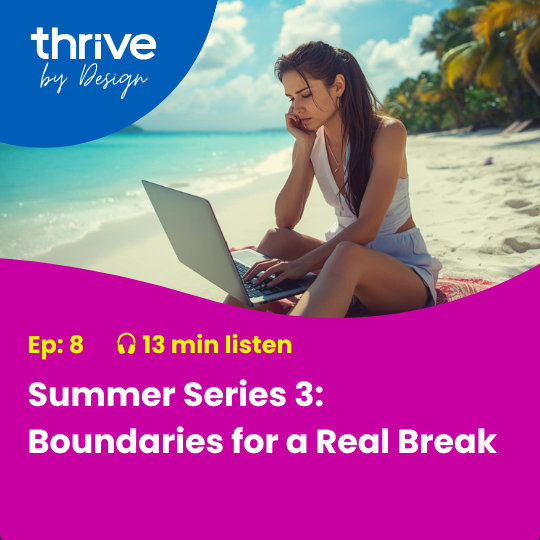
Technology is one of the biggest risks to a proper holiday because it blurs every line. You can be lying on a beach thinking about nothing in particular, and suddenly a notification flashes up - and bang, you’re right back in work mode.
So part of creating a real break is controlling your access points.
Deleting the apps.
Logging out.
Turning off notifications.
Or even just moving work-related icons to a separate screen where they’re not staring you in the face every time you open your phone.
You don’t realise how often you check things until you stop having access to them. It’s almost muscle memory.
Removing the temptation gives your brain permission to fully exhale.
And if you’re someone who needs a little bit of oversight to feel calm, that’s totally fine - just create a container for it.
Maybe you check in once a week for 20 minutes. Maybe you have a single day mid-break where you just clear the decks lightly.
The key is intentional access, not accidental access.
Personal Boundaries - Deciding How You Actually Want to Feel
This is the boundary most entrepreneurs skip entirely - deciding what they actually want from their break.
It’s easy to think, “I just want to rest,” but rest looks different for everyone.
Some people want slow days.
Some want stimulation and adventure.
Some want alone time.
Some want connection with their favourite people.
Some want to swim and nap and read and drink iced coffee.
Some want to use the space to dream about the year ahead without pressure.
It doesn’t matter what the answer is - it only matters that you get intentional about it.
Because when you’re clear on how you want to feel, the boundaries you need suddenly become obvious.
You’re not setting boundaries to keep people out.
You’re setting them to make sure you can access the version of yourself that only emerges when you’re rested.
A Simple Reflection - Your Holiday Boundary Blueprint
Before your break begins, take a moment and ask yourself two simple questions:
“What drains me at this time of year?”
and
“What restores me?”
Just two questions - but the answers tell you everything.
If what drains you is last-minute work, constant notifications, or the feeling of being on call…
and what restores you is sunshine, unhurried mornings, conversations with people you love, or simply not making decisions for a week…
then the boundary work becomes obvious.
You design your break around what restores you, not what drains you.
You protect that.
You honour it.
That becomes your personal boundary blueprint - and it’s different for everyone.
The Mindset Shift- Boundaries Are Not Barriers
Let’s talk about the emotional side, because boundaries aren’t just practical - they’re psychological.
Most entrepreneurs don’t struggle because they can’t set boundaries.
They struggle because they feel guilty enforcing them.
There’s this quiet fear that if you step away, clients might feel neglected, opportunities might disappear, or things might unravel.
But those fears are rarely grounded in reality.
They’re grounded in habit - in being used to being needed.
The truth is, holding a boundary is not an act of selfishness.
It’s an act of leadership.
What you’re really saying is,
“I know how I work best, and I’m taking responsibility for protecting that.”
And when you model that, the people around you - clients, team, family - often respond with respect, not resistance.
How Breaks Actually Strengthen Your Business
Something interesting happens when you hold boundaries around your break: your business becomes more resilient.
Clients learn that you operate with structure, not chaos.
Team members step up because they have clarity and autonomy.
Systems get tested, and the gaps become visible in a healthy way.
But most importantly, you return with perspective you simply cannot access when you’re grinding.
You see your business more clearly.
You spot opportunities.
You feel more decisive.
You reconnect with your purpose.
And you start the year not on your knees, but with momentum.
Breaks aren’t a luxury for entrepreneurs.
They’re strategy.
Boundaries as a System, Not Willpower
At Thrive, one of the things we talk about a lot is designing your business to support your boundaries, rather than relying on willpower.
Because willpower fades the moment your phone buzzes.
Systems don’t.
When you put the right structures in place - the right communication rhythms, client expectations, team processes, and personal routines - your boundaries become easier to uphold.
They stop being something you fight for, and start becoming the natural way you run your business.
That’s thriving by design.
Not thriving by accident.
Not thriving by pushing harder.
Thriving because you built your business to honour your life.
Protecting Your Re-entry
I want to circle back to the return-from-holiday conversation, because this is where a lot of great breaks get undone.
Think about how you feel after a proper summer reset.
You’re lighter.
Calmer.
Clearer.
More open.
If you go straight from that into a fully loaded schedule - meetings back-to-back, deadlines waiting, inbox overflowing - that clarity evaporates almost instantly.
But if you protect those first few days back?
You give yourself the chance to ease in.
To check in with clients intentionally.
To reconnect with your strategy.
To decide what your priorities actually are, instead of jumping back into everything you used to do.
That re-entry boundary is one of the most powerful ones you can put in place.
Final Thoughts
As you head into the summer, I want you to imagine what it would feel like to take a break that actually works.
One where you’re not half-checking emails.
Not squeezing in “one more thing.”
Not micromanaging from the beach.
Not carrying the invisible weight of your business around with you.
Imagine a break where you truly switch off.
Where you reconnect with yourself, your people, your energy.
Where you remember why you started this business in the first place.
That version of rest isn’t just possible - it becomes almost inevitable when your boundaries are clear, intentional, and supported.
Because thriving isn’t about working harder.
It’s about building a business - and a life - that honours you.
Until next time…
keep thriving, but do it by design, not by default.
Crafting a Business You Love
Build a business that works for you. This free guide will help you realign your strategy, simplify what’s holding you back, and design a business that gives you more time, freedom, and fulfilment.
Get your free copy and start crafting a business you truly love.