When Planning Feels Pointless
There’s something I’ve seen over and over again in my own business and with clients and I wonder if this will feel familiar to you.
You start the quarter feeling really clear. You’ve done the planning, you know your priorities, you’ve mapped out the projects, and you feel that little spark of excitement. This is the quarter you’re going to stay focused. This is the one where you finally create some breathing room, move the needle, and actually get ahead.
And for a week or two, everything feels great. You’re organised. You’re optimistic. You’re ready.
And then… life happens. A client suddenly needs something. A big opportunity lands in your inbox and blows up your week. Maybe you get sick, one of the kids gets sick, or you’re just a bit more tired than you expected.
And slowly - sometimes so slowly you don’t even notice it at first - the plan you were so excited about quietly slips into the background. Not because you don’t care. Not because you’re bad at follow-through. And definitely not because you’re not capable.
But simply because planning and momentum are two entirely different skills.
And most of the time, nobody teaches us how to build momentum. We learn how to make plans - beautifully, in fact - but we’re never taught how to keep going when the day-to-day realities of business start pulling us in every direction. So that’s what I want to talk to you about today. Not planning in the traditional sense - we covered that in the last episode.
Today is about what happens after the plan is made. How do you keep moving? How do you stay in motion, even when things get messy? How do you build a business that actually follows through on the work you mapped out so intentionally?
That’s where the Momentum Engine comes in. This is the part that most entrepreneurs skip - and it’s the reason so many beautifully crafted plans never make it to the finish line.
When you understand how to fuel your Momentum Engine, everything feels easier. You stop relying on motivation - because motivation is unreliable. You stop depending on willpower - because willpower is inconsistent. And you start building the kind of rhythm and energy that makes progress feel natural, rather than forced. Let’s explore it together.
Why Momentum Matters More Than Motivation
One of the biggest misunderstandings in business is that successful people are simply more motivated. But motivation is… fickle. It’s emotional. It rises and falls depending on your energy, your sleep, your hormones, your stress levels, the weather - honestly, anything.
Momentum, on the other hand, is mechanical. Once something is moving, it wants to keep moving.
And the same is true for us. You’ve felt it, right? Those periods where you’re in flow, ticking things off your list, making progress without having to push yourself. It’s not that the work is easier - it’s that you’re already in motion.
But the opposite is also true. When your momentum stalls, it takes so much more energy to get going again. And that’s where most entrepreneurs find themselves stuck: not because they lack clarity, but because they’ve lost momentum and don’t know how to restart it.
That’s where the Momentum Engine comes in.
Introducing The Momentum Engine
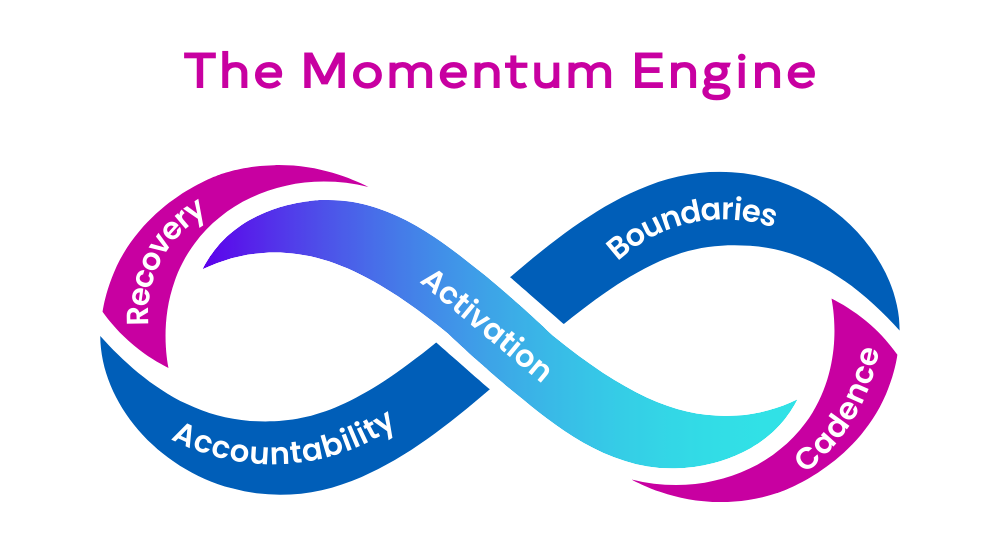
The Momentum Engine has five parts - and they work together like gears. If one gear stops turning, the whole system slows down. But when they all move together, progress becomes almost unavoidable. The five parts are:
Activation → Cadence → Boundaries → Accountability → Recovery
Let’s walk through each part and unpack what actually helps you keep going once the excitement of planning fades.
1. Activation - Getting Started Before You Overthink It
Activation is that very first moment you take action on your plan. It’s the bridge between your intentions and your behaviour. And if we’re honest, starting is the hardest part. Not because the work itself is difficult, but because the beginning feels heavy. There’s uncertainty. There’s perfectionism. There’s the pressure of wanting to get it right the first time.
But activation isn’t about doing it perfectly - it’s about lowering the barrier to entry so you can simply begin. Sometimes that looks like giving yourself just 15 minutes to make a start. Sometimes it’s opening the document and writing a rough outline instead of waiting until you have the full idea. Sometimes it’s sending a first message, a first draft, a first imperfect step.
Once you’re in motion, everything becomes easier. Activation is simply the decision to move - even if it’s small, even if it’s messy.
2. Cadence - Finding a Rhythm That Feels Good to You
Once you’ve started, the next question is: How do I keep this going?
And this is where cadence comes in. Cadence is the rhythm that carries you from week to week. It’s the reason some businesses grow steadily while others have good intentions and no movement.
Cadence isn’t about having a perfectly scheduled week - we’re not creating corporate calendars here. Cadence is more about having recurring touchpoints with your work. Little anchors in your week that keep your plan alive.
For some people, that looks like a Friday CEO session where they reflect on the week and adjust the focus for the next. For others, it’s a Monday morning planning ritual with a coffee and a clean notebook. For some, it’s a monthly reset or a quarterly review.
Cadence isn’t rigid - it’s supportive. It gives your progress a heartbeat. And that heartbeat compounds over time.
When you stay connected to your work in a steady, rhythmic way, you don’t have to keep restarting your momentum. It’s already there, ready for you.
3. Boundaries - Protecting the Space Where Your Momentum Lives
Now, this is the part many entrepreneurs struggle with - myself included.
You can have the clearest plan and the best intentions, but if you don’t have boundaries around the time and energy needed to do the work, your plan will simply get swallowed by the day-to-day demands of business.
I’ll share something personal here. Every Wednesday afternoon, I have a block in my calendar for working on the business. Strategy, planning, content - the things that move the business forward.
And honestly? For a long time, that block was the easiest thing to bump. If a client needed something urgently, I’d shift it. If I was tired, I’d tell myself I’d do it later. If someone wanted to book a meeting, I’d squeeze them in.
But the truth is, every time I did that, I wasn’t rescheduling my CEO time - I was removing it entirely. And the business felt it.
Momentum evaporates when the time meant to fuel it is constantly sacrificed. So I had to start treating that Wednesday block as sacred. A real commitment. Not optional. Not flexible. And yes, that required some uncomfortable conversations - mostly with myself. But it transformed the consistency of my results.
Boundaries aren’t walls to keep people out. They’re commitments to keep your future self-supported. When you protect the space where your momentum lives, you honour the work that matters most.
4. Accountability - Staying Connected to Your Commitments
We often think accountability is something external - someone checking that we’ve done the thing, or a group holding us to our goals. And those things can help, absolutely.
But accountability is really about staying connected to your own commitments. It gives you perspective. It prevents drift. It helps you notice when things are going off track sooner, not six weeks later. And honestly, it just feels good to be witnessed in your progress.
For some people, accountability looks like a business buddy they check in with weekly. For others, it’s a mastermind or a coach. And for many, it’s simply having a place like Thrive HQ where they can share wins, challenges, next steps, and feel supported in the in-between moments.
Accountability doesn’t exist to shame you into moving - it exists to encourage you forward. It’s that gentle nudge that says: “Hey, remember what you said you wanted? Let’s keep going.”
5. Recovery - Restarting Quickly When Your Momentum Slips
And finally, we have recovery - the piece almost nobody talks about. Because here’s the truth:
You will lose momentum. Plans will go sideways. Life will get in the way.
The goal isn’t to avoid losing momentum - the goal is to know how to recover quickly without spiralling into guilt or all-or-nothing thinking. Recovery is simply the ability to pause, breathe, reconnect, and restart. Sometimes it’s as simple as asking yourself:
“Okay, what matters now?”
“What’s one small step I can take today?”
Recovery isn’t dramatic. It isn’t a full reset. It’s more like a gentle recalibration.
Instead of waiting for the perfect moment to restart, you take one small action - and momentum begins to build again.
That’s the beauty of it: momentum isn’t destroyed by falling behind. It’s destroyed by staying there.
What the Momentum Engine Looks Like in Real Life
To bring this to life, I want to share a story about someone I worked with recently - a brand strategist who came to me feeling like she was constantly playing catch-up. And if you’ve ever felt like you’re doing a lot but not really moving forward, her experience might sound familiar.
Every quarter, she’d sit down with the best intentions. She loved planning - the clarity, the structure, the fresh start. But a few weeks in, she’d find herself drifting. Client work would take over, unexpected tasks would pop up, and before she knew it, her beautifully mapped-out plan was somewhere in the background… waiting for “when things settled down.”
But things never really settled. And she thought the solution was to push harder, work longer hours, or create an even more detailed plan.
The real shift happened when she stopped trying to perfect the planning process and started building her Momentum Engine instead. She:
Began activating tasks quickly rather than overthinking her first step.
Created a simple weekly cadence that kept her connected to her goals without overwhelming her.
Protected a small block of CEO time each week - even when it was uncomfortable at first.
Added accountability by checking in with a peer who helped her stay grounded in her priorities.
And maybe most importantly, she stopped beating herself up when things slipped. She learned how to recover with kindness and restart quickly.
Six months later, she felt ahead for the first time in years. Not because her workload magically became lighter. Not because she suddenly discovered more hours in the day. But because she was no longer stopping and starting. Her momentum was carrying her. And that’s exactly what this model is designed to create. Not perfection. Not hustle. Just steady, compounding forward motion - the kind that feels doable, sustainable, and deeply supportive of the business you’re building.
How to Start Building Your Momentum Engine This Week
I’m not going to give you a long list here. Instead, I want to bring this into one simple thought:
Momentum begins with the next step - not the whole staircase.
So this week, choose one project from your plan… and activate it. Make the smallest possible start. Send the email. Open the document. Outline the idea.
And then ask yourself:
What rhythm do I want around this?
What boundary will protect it?
Who can walk alongside me?
And when things slip - because they will - how can I gently restart?
Building momentum isn’t about intensity. It’s about intention. And when you approach it this way, everything gets lighter. Everything gets easier. Everything becomes more sustainable. Because you’re no longer relying on motivation to carry you - you’ve built an engine that can keep moving, even when you need to slow down.
A Closing Thought …
So as you head into your week, I want you to remember this: Your business doesn’t need you to be perfect. It needs you to stay in motion. Even slowly. Even gently. Even imperfectly. Momentum is created by design - not by default.
Until next week, keep thriving - but do it by design, not by default.
Crafting a Business You Love
Build a business that works for you. This free guide will help you realign your strategy, simplify what’s holding you back, and design a business that gives you more time, freedom, and fulfilment.
Get your free copy and start crafting a business you truly love.